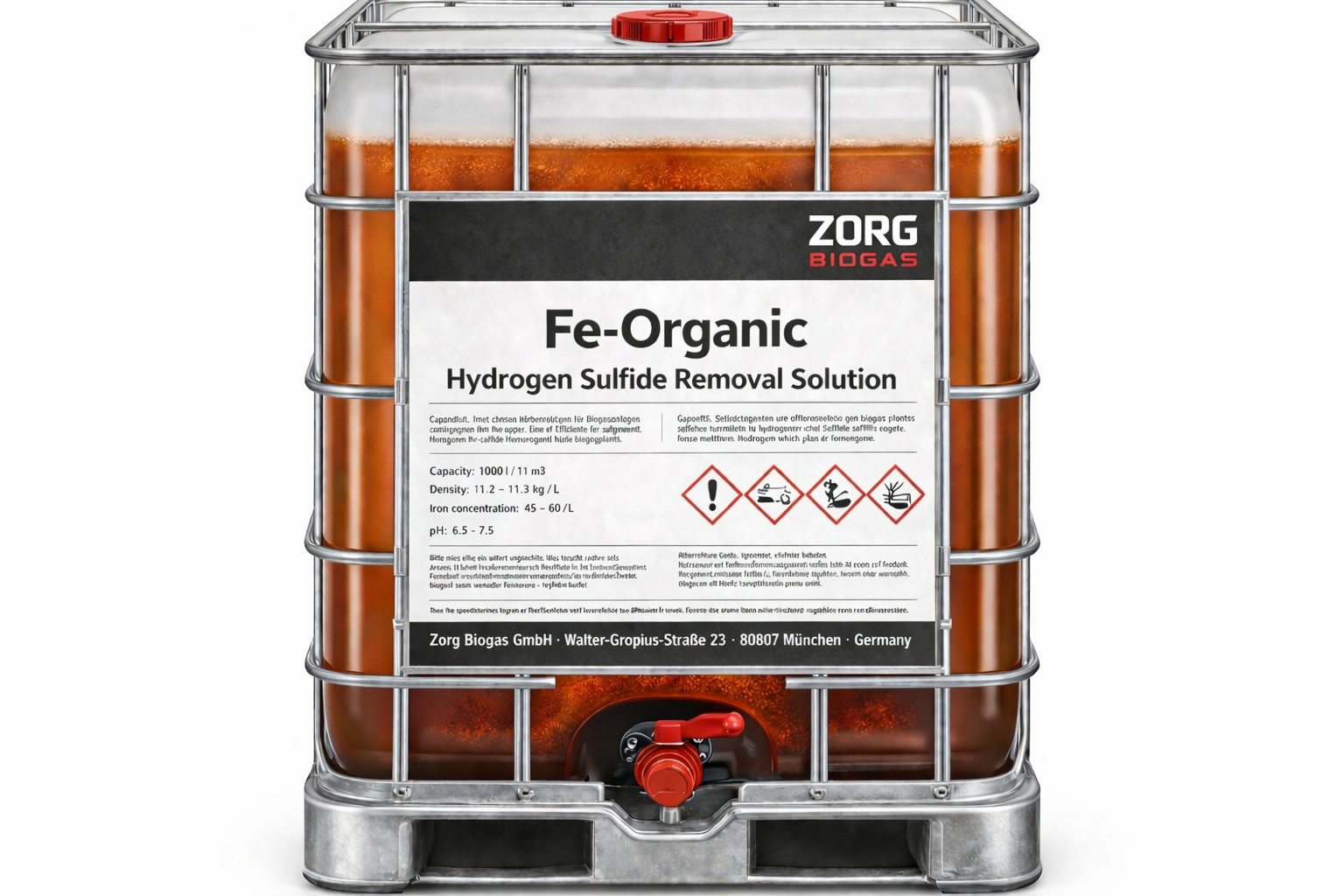
Fe-organic for H₂S Removal
€ 11,00/kg
Fe-organic for H₂S removal is a chelated iron solution designed for hydrogen sulfide reduction and desulphurisation directly inside anaerobic digesters. The product helps to protect pipelines and reinforced concrete structures while reducing trace-element binding and minimizing sludge formation compared to FeCl₃ and iron hydroxide.
Why Remove H₂S Inside the Digester
Hydrogen sulfide causes:
- corrosion
- pipeline damage
In-situ desulfurization significantly reduces maintenance costs.
Trace Element Protection
Hydrogen sulfide binds essential micronutrients:
Co → CoS
Mn → MnS
Mo → MoS₂
Cu → CuS
This leads to:
- process instability
- reduced methane yield
- higher trace element consumption
Fe-organic prevents these reactions.
Operating Principle
H₂S + 2Fe³⁺-chelate → S⁰ + 2Fe²⁺-chelate + 2H⁺
2Fe²⁺-chelate + ½O₂ + H₂O → 2Fe³⁺-chelate + 2OH⁻
Advantages:
- catalytic reaction mechanism
- reduced iron consumption
- formation of elemental sulfur instead of FeS sludge
No Cross-Reactions with Phosphates or Carbonates
Unlike FeCl₃ and Fe(OH)₂:
- no phosphate or carbonate precipitation
Behavior of Fe(OH)₂ in the Digester
Fe(OH)₂ is effective only within a narrow range: pH 8.3 – 9.8
Advantages: useful as an emergency correction reagent
Limitations:
- narrow effective operating window
- cross-reactions with carbonates and phosphates
Use of FeCl₂ as an Alternative Reagent to FE-organic
FeCl₂ can be applied as a lower-cost alternative.
However:
- possible formation of HCl
- increased corrosion risk
Additionally:
- digestate agricultural application performance may be negatively affected.
Performance Equivalence
2 kg ZORG' Fe-organic replaces approx. 20 kg iron hydroxide granulate (30-40% Fe)
≈ 6,5 kg elemental iron removal performance
Recommended Dosage
Example.
1 MW maiz-based biogas plant. H2S 2000 ppm. CSTR reactor. Temperature +38°C. Organic load 2-5 kg oDM/m³ reactor/ day. Using 4 kg of Fe-Organic/day reduces H2S in the biogas by 97% to 60-80 ppm at the reactor outlet.
Typical Applications
Suitable for:
- agricultural biogas plants
- poultry manure digestion
- protein-rich substrates
- waste digestion
Organic Farming Restriction: Fe-Organic is not recommended for certified "bio" and organic digestate application. Instead of EDTA another chelate is used.
Technical Details
Application
Appearance:
red-brown liquide
Packaging:
IBC container
Chemical name
ferrum chelate
Technical Details
Appearance:
red-brown liquide
Packaging:
IBC container
Chemical name
ferrum chelate