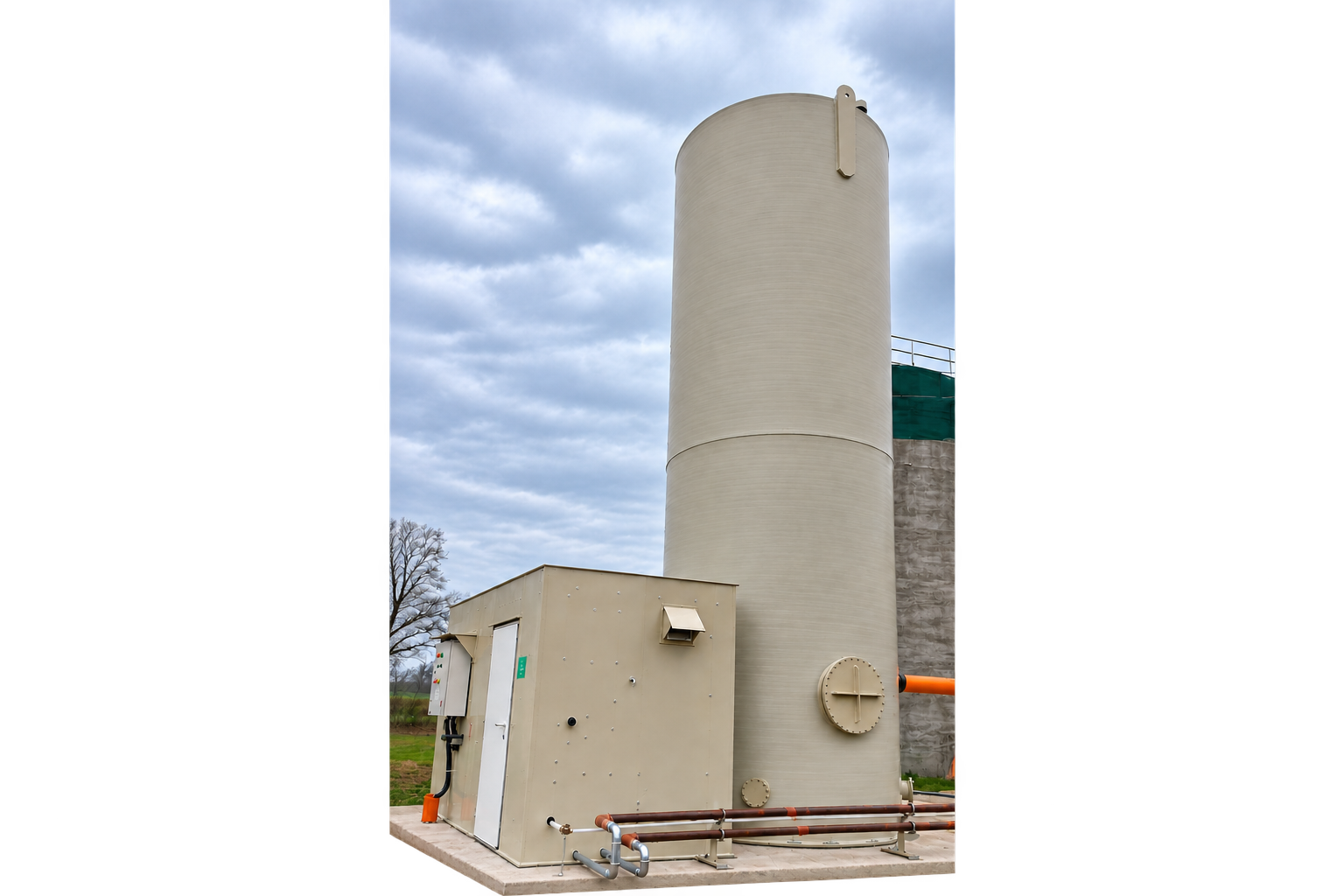
Biogas Desulphurisation Scrubber 1100 m³/h – H₂S 2,500 to 150 ppm
€ 147.000,00
Biological desulphurisation using a conventional biotrickling scrubber is a proven technology for removing hydrogen sulphide (H₂S) from biogas, sewage gas and landfill gas. The process is also known as microbial desulphurisation. Other commonly used terms include biogas scrubber, biological scrubber, bio-scrubber, biotrickling scrubber, biotrickling reactor and bio-bed reactor.
The H₂S-containing biogas passes through a scrubber filled with filter media. Microorganisms colonise the surface of the filter media and form an active biofilm. In the presence of oxygen, they biologically oxidise hydrogen sulphide to elemental sulphur and sulphates.
Nutrients are added to maintain biological activity, while the process liquid is continuously circulated through the scrubber. Sulphur and sulphates accumulate in the circulating liquid, and a portion of the sulphur- and sulphate-containing process liquid is discharged from the system. It can be directed to a wastewater treatment plant or, at biogas plants, to digestate storage.
Microorganisms of the Thiobacillus (Thiooxidans) type are used. These bacteria are chemolithotrophic and use carbon dioxide as their carbon source. The oxygen required for their metabolism is supplied as process air.
The process air supply is automatically regulated according to the biogas flow rate using a 4–20 mA signal from the biogas flow measurement. Air is supplied by a frequency-controlled blower, allowing the oxygen supply to follow changes in biogas flow and H₂S load.
The scrubber tank is manufactured from PP (polypropylene). Due to the low pH of the circulating process liquid, process piping and components in contact with the liquid are manufactured from corrosion-resistant polymer materials.
The circulation system continuously distributes process liquid over the filter media, providing contact between the biogas, microorganisms, oxygen and liquid phase. Fresh water and nutrients are supplied automatically according to process requirements, while sulphur- and sulphate-containing process liquid is periodically or semi-continuously discharged.
The process liquid temperature is maintained by an integrated heating system with 80 kW maximum heating capacity, a DN50 connection and 400 m of internal heating piping. Heating is automatically controlled according to the process liquid temperature.
The control cabinet and process equipment are installed in a PP technical room equipped with ATEX ventilation, frost protection and methane detection.
The instrumentation and control system includes an Endress+Hauser pH meter, level measurement, process liquid and process air flow measurement, process liquid temperature measurement, Honeywell ATEX methane sensor, frequency converters and automatic process control. The system supports 4–20 mA signal transmission and Siemens ET 200 SP communication via PROFINET, PROFIBUS and Modbus.
A major advantage of biological desulphurisation compared with activated carbon filters or chemical scrubbers is that no additional chemicals such as NaOH or H₂O₂ are required for H₂S removal. Only small quantities of nutrients are required to maintain the biological process.
The scrubber is designed for a biogas flow rate of 1,100 m³/h and an inlet H₂S concentration of 2,500 ppm. It achieves an H₂S removal efficiency of 94%, reducing the hydrogen sulphide concentration to ≤150 ppm.
Technical Details
Features
Standard scope of supply
Flow rate, actual m³/h:
1100
Flow rate under normal conditions, Nm³/h:
1000
H₂S inlet concentration
2,500 ppm
H₂S outlet concentration
≤150 ppm
H₂S mass load
4.13 kg/h
Pressure drop
5–8 mbar
Minimum inlet pressure, mbar
3
Operating pressure, mbar
40
Gas connection DN, mm:
350
Volume and umber of scrubbers
125 m3 x 1
Diameter and Height, mm:
3400 × 13000
Filling media volume, m³:
108
Water use, max l/h
438–460
Water connection
DN32
Nutrient consumption, kg per day
7 kg
Electrric power demand, kW
13
Average consumption, kWh/h
10
Process air addition,
11–14% of raw biogas flow
Air blower flow and pressure
140 m³/h at 80 mbar
Heating capacity/ connection / length of coils
80 / DN50 / 400
Technical Details
Flow rate, actual m³/h:
1100
Flow rate under normal conditions, Nm³/h:
1000
H₂S inlet concentration
2,500 ppm
H₂S outlet concentration
≤150 ppm
H₂S mass load
4.13 kg/h
Pressure drop
5–8 mbar
Minimum inlet pressure, mbar
3
Operating pressure, mbar
40
Gas connection DN, mm:
350
Volume and umber of scrubbers
125 m3 x 1
Diameter and Height, mm:
3400 × 13000
Filling media volume, m³:
108
Water use, max l/h
438–460
Water connection
DN32
Nutrient consumption, kg per day
7 kg
Electrric power demand, kW
13
Average consumption, kWh/h
10
Process air addition,
11–14% of raw biogas flow
Air blower flow and pressure
140 m³/h at 80 mbar
Heating capacity/ connection / length of coils
80 / DN50 / 400